

Authors
Abstract
Background: The esthetic characteristics of the face and nose are commonly evaluated before rhinoplasty using a completely subjective method, due to the lack of validated and reliable methods for quantifying facial esthetics and for accurate nose treatment planning. The aim of the study was to review the literature to determine and evaluate the points, distances, and angles commonly used in the treatment planning for rhinoplasty.
Methods: Research based on anthropometric studies of the face and nose, published from 1987 to 2018, was included. Finally, 138 papers were selected after a statistical analysis through a simple random and non-random sample selection, and all papers were evaluated in their entirety.
Results: According to the frequency of citation, 198 points, 336 distances, and 199 angles were listed. A group of 49 points, 77 distances, and 11 angles was classified according to their anatomical region (bone and soft tissues).
Conclusions: An enormous inhomogeneity and lack of a standardized anthropometric measurement system, specifically of the nose, was evident, as the studies were conducted by authors of different origins. The importance of a reliable method for nose surgery planning is highlighted.
Keywords: fat graft; lipofilling; maxillo-facial surgery; orofacial SSc; systemic sclerosis.
DOI
Citazione
Condividi questo articolo scientifico...
Altri articoli pubblicati

Gennaio 2023
J Clin Med. 2023 Jan 20;12(3):845. doi: 10.3390/jcm12030845. [...]

Dicembre 2022
The aim of this retrospective study has been to compare the surgical outcomes of patients undergoing superficial parotidectomy with three different instruments
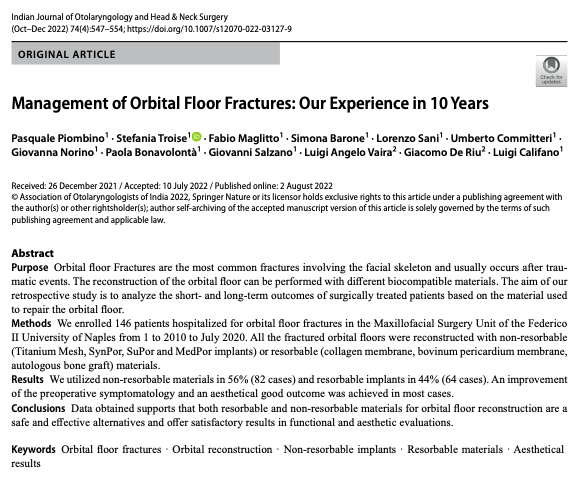
Dicembre 2022
Indian J Otolaryngol Head Neck Surg. 2022 Dec;74(4):547-554. doi: [...]