

Authors
Abstract
The purpose of our study was to evaluate the benefits of the SMAS flap in patients with benign tumours of the parotid gland treated by superficial parotidectomy. We carried out a retrospective chart review on 123 patients suffering from benign tumours of the parotid gland admitted to our Institution between March 1997 and March 2010. A superficial parotidectomy was performed in all the cases reported. Our sample was divided in two groups basing SMAS flap reconstruction done (Group 2) or not (Group 1) after superficial parotidectomy. Reconstruction using SMAS flap was accomplished in 64 patients. Chi-square test was used to assess statistical difference between the two groups. The level of statistical significance was P < 0.05. No significant differences concerning hematoma, wound infection and facial paralysis were observed between the first and second group (3.38 vs 1.56% [P > 0.05], 8.47% vs 4.68% [P > 0.05], 5.08% vs 0.00% [P > 0.05]). Transient facial nerve weakness, fistula, dip skin and Frey’s syndrome were significantly more frequent without SMAS flap reconstruction (10.16% vs 3.125% [P < 0.05], 13.55% vs 3.125% [P < 0.05], 13.55% vs 3.125% [P < 0.05], 20.33% vs 0% [P < 0.05] respectively). The use of the SMAS flap is able to reduce the cosmetic and functional complications that occur after the removal of a benign tumour of the parotid through the superficial parotidectomy technique, above all, it reduces the occurrence of Frey’s syndrome.
Keywords: Facial nerve palsy; Frey syndrome; Parotidectomy; SMAS flap.
DOI
Citazione
Condividi questo articolo scientifico...
Altri articoli pubblicati
Settembre 2024
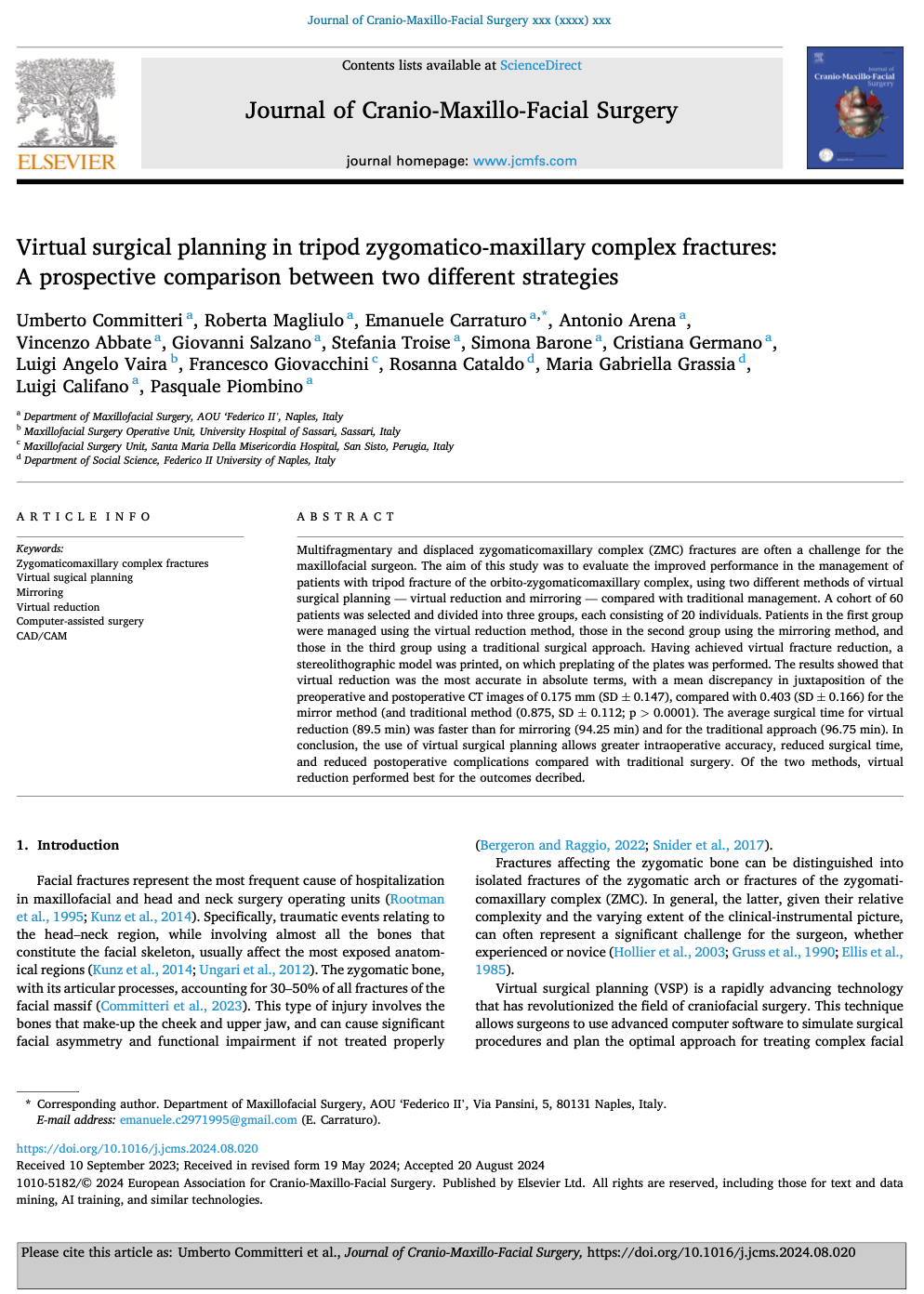
The use of virtual surgical planning allows greater intraoperative accuracy, reduced surgical time, and reduced postoperative complications compared with traditional surgery. Of the two methods, virtual reduction performed best for the outcomes decribed
Settembre 2024
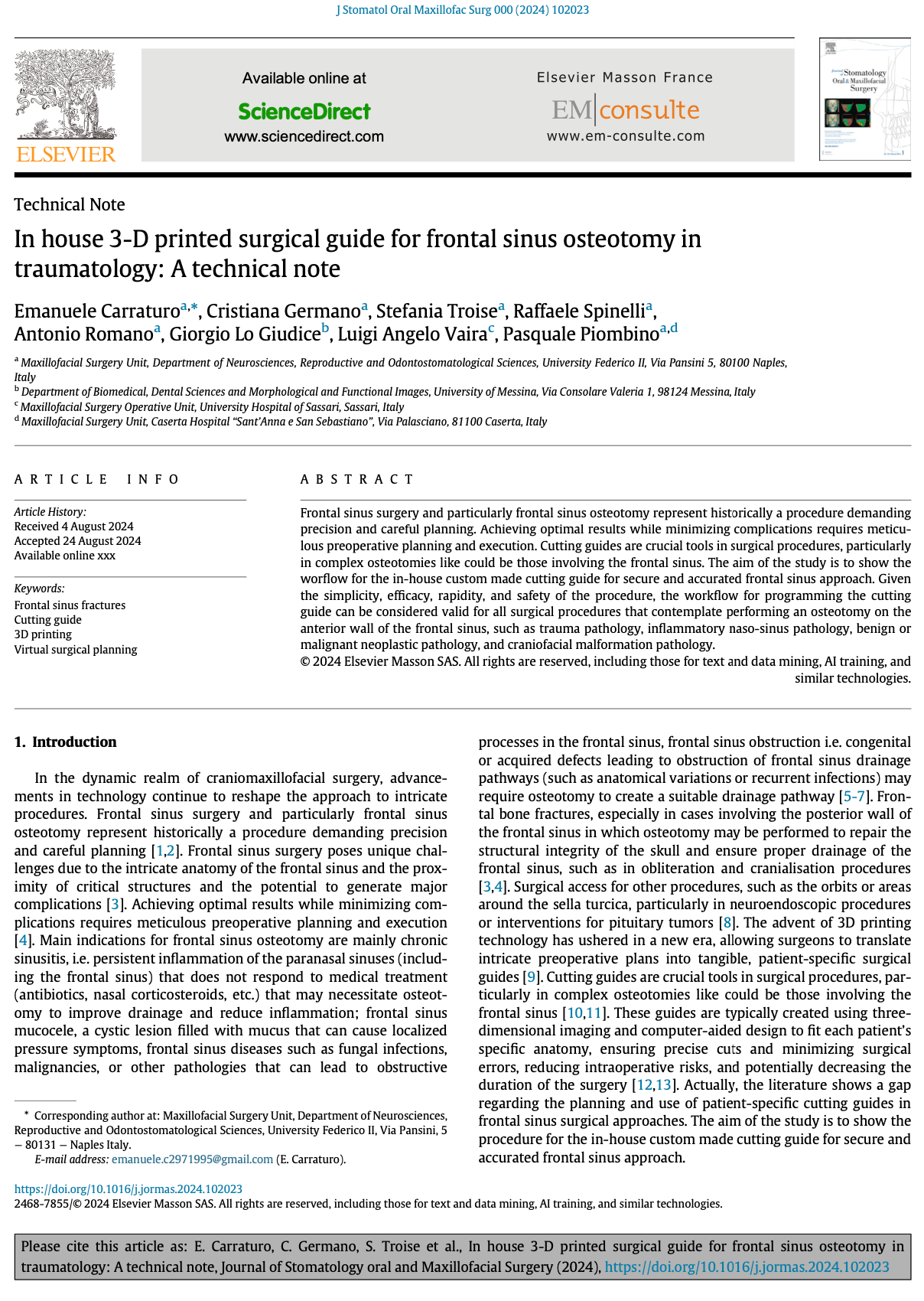
J Stomatol Oral Maxillofac Surg. 2024 Aug 30:102029 [...]
Settembre 2024
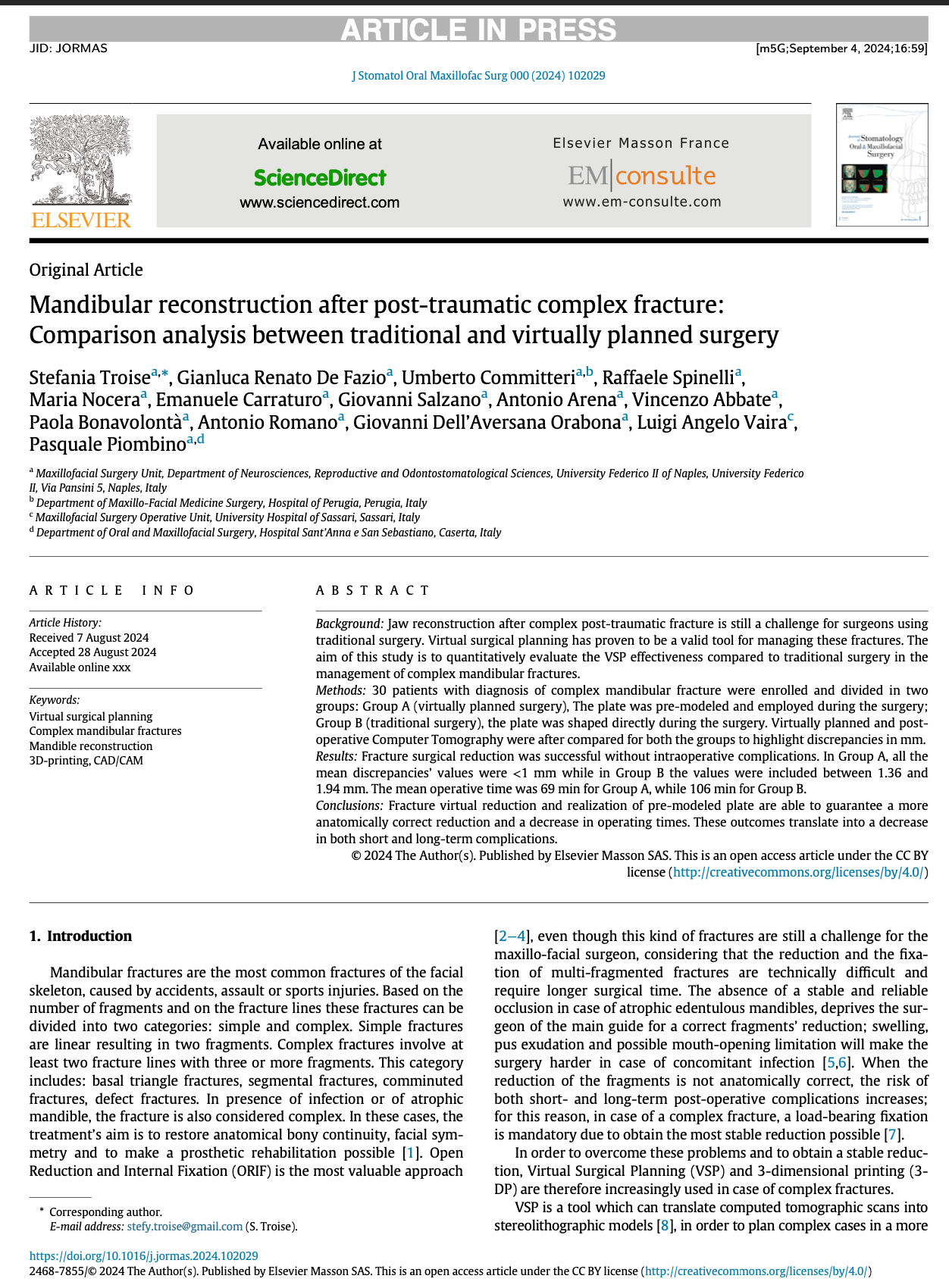
Fracture virtual reduction and realization of pre-modeled plate are able to guarantee a more anatomically correct reduction and a decrease in operating times. These outcomes translate into a decrease in both short and long-term complications.